
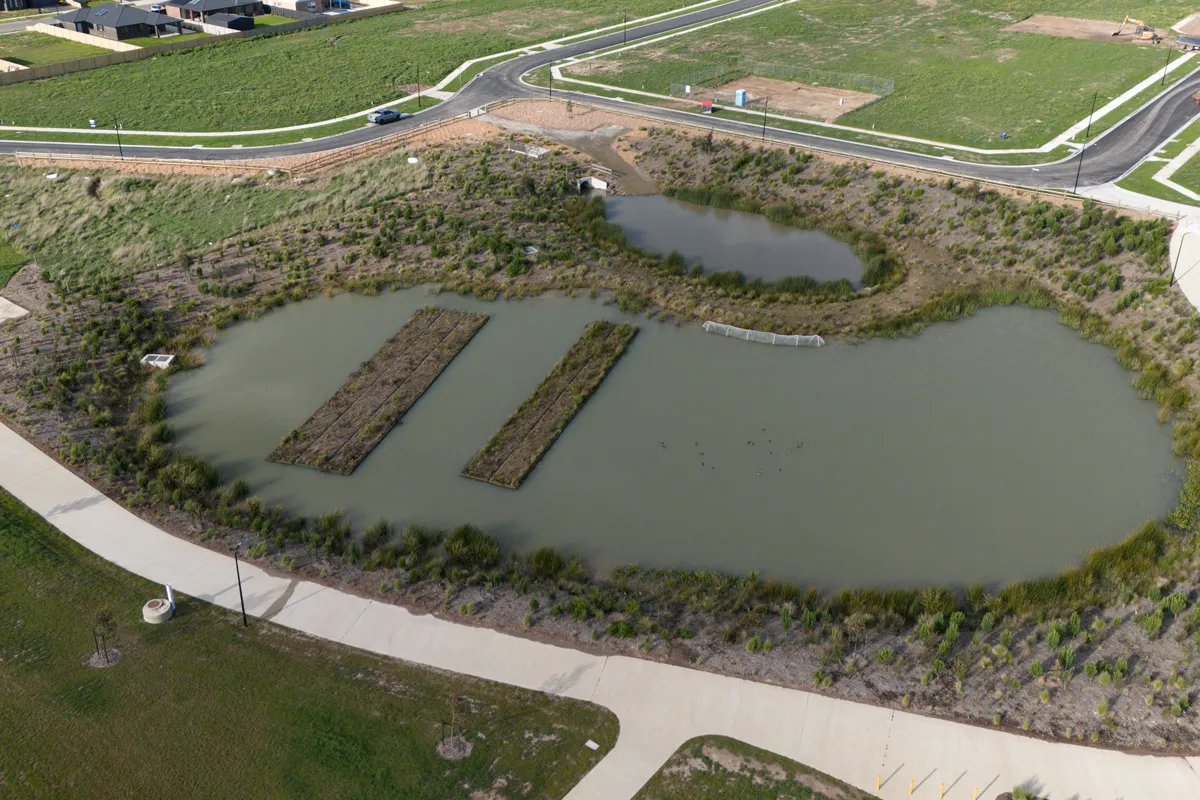
Floating treatment wetlands cost less to create, install faster, and require less land take than traditional constructed wetlands — here’s some key differences in their economic impacts.
Constructing a traditional wetland requires land acquisition, earthworks, grading, planting, and an extended establishment period before the system reaches full performance. The costs add up quickly — especially in developed areas where land is scarce, foreshore is crowded, and labor is intensive.
Floating Treatmet Wetlands (FTWs) provide an alternative that mitigates these cost bases. Deployed on existing water bodies, there’s no earthmoving, land purchase, or construction footprint beyond the water’s surface and FTW anchoring systems. Installation typically requires just one or two days, compared to weeks or months for a traditional constructed wetland.
Ongoing maintenance is also straightforward. The plants need periodic attention, and routine inspections keep the system performing optimally — but there’s no complex mechanical infrastructure to service, and the modular design allows crews to access every part of the system directly.
The plant baskets in Atlan Stormwater’s Floating Treatment Wetlands can be removed, replaced, or relocated with minimal labor costs. Plant baskets easily replaced or rotated, and weeds can be removed directly from the growth media.
Nature-Based Stormwater Engineering for Pilot Programs & Multiphase Projects
Floating Treatment Wetlands are ideal for pilot programs and multiphase projects – environments where wetland installations can be extended to meet changing catchment, community or environmental requirements. Atlan Floating Treatment Wetlands are modular by design, meaning they are ideal for relocating, reconfiguring, and adding additional modules.
Not every project has the budget or funding for a large-scale wetland installation from day one. FTWs are modular by design, which means they’re ideal for phased approaches and pilot programs – and can be integrated with other parts of the stormwater network as they come online.
You can start with a small installation, generate real data on water quality improvement, build community support, and then expand the system over time by adding modules. The platforms can be reconfigured, relocated, and adapted as your goals evolve — something no traditional constructed wetland can offer.
This flexibility also makes FTWs well-suited to grant-funded projects. Their relatively low capital cost, fast deployment, and measurable outcomes align well with the requirements of federal and state green infrastructure funding programs.
FTWs deliver optimal performance when integrated within a broader treatment train. As developments and upstream infrastructure change, FTWs can be paired with devices such as GPTs (Gross Pollutant Traps). These reduce coarse sediment and litter loads entering the wetlands environments, reducing root zone clogging, and lowering maintenance requirements.
The GPT intercepts gross pollutants at the source; the FTW addresses dissolved nutrients, fine sediment, and biological constituents that pass through primary treatment. Together, they address the full stormwater pollutant spectrum — from gross pollutants to dissolved nitrogen and phosphorus — within a compact, cost-effective treatment train.
FAQ
How do floating wetlands compare to traditional constructed wetlands in terms of cost and installation?
Floating treatment wetlands significantly reduce upfront costs by eliminating the need for land acquisition, excavation, and large-scale civil works. Installed directly on existing water bodies, they can typically be deployed within days rather than months, making them a faster and more cost-effective alternative—especially in urban environments where land and construction costs are high.
Why are floating wetlands well-suited for phased projects and pilot programs?
Floating wetlands are modular by design, allowing projects to start small and expand over time as funding, data, and stakeholder support grow. Systems can be reconfigured, relocated, or scaled by adding modules, enabling municipalities and developers to adopt a staged approach that aligns with evolving site conditions and budget constraints.
How do floating wetlands integrate with other stormwater treatment systems?
Floating wetlands are most effective when used as part of a broader treatment train, often paired with primary devices like gross pollutant traps (GPTs). While GPTs capture litter and coarse sediment upstream, floating wetlands target dissolved nutrients, fine particles, and biological pollutants, together delivering comprehensive stormwater treatment within a compact footprint.