
Applications of Floating Treatment Wetlands
Practical Solutions
Real-world water challenges
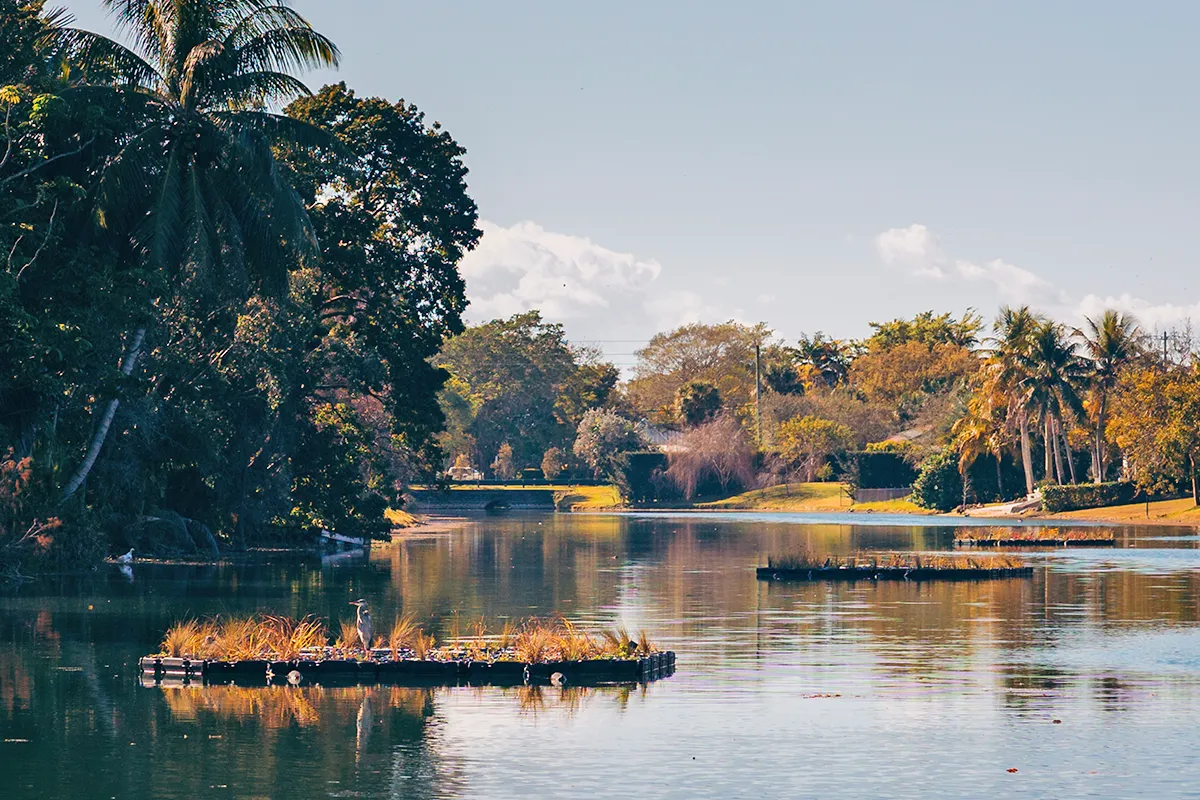
Floating Treatment Wetlands (FTWs) are designed to work within existing water bodies, making them one of the most adaptable tools for improving water quality across urban, industrial, and environmental settings.
Whether you’re upgrading ageing infrastructure or planning a new development, FTWs can be configured to suit a wide range of applications without requiring major land use changes.
Every site has different challenges and opportunities
Designed for flexibility across every application
Urban lakes & public waterways
Urban lakes often suffer from nutrient buildup, poor circulation, and declining visual appeal.
How FTWs help:
- Reduce nutrients that drive algal blooms
- Improve water clarity and overall appearance
- Enhance biodiversity and habitat
- Create greener, more inviting public spaces
This makes them ideal for councils focused on both environmental outcomes and community experience.
Stormwater basins & retention ponds
Stormwater basins are often designed for flow management, not water quality — leaving them prone to sediment and nutrient issues.
How FTWs help:
- Capture suspended solids and improve clarity
- Absorb nutrients from urban runoff
- Enhance performance of existing infrastructure
- Retrofit easily into existing basins
They provide a cost-effective upgrade without redesigning the entire system.
Rivers & estuarine systems
Flowing water systems present unique challenges due to movement, variability, and pollutant loads.
How FTWs help:
- Intercept pollutants along flow paths
- Stabilise water quality in key zones
- Provide habitat in otherwise constrained environments
- Adapt to changing water levels
Careful placement allows FTWs to improve outcomes without disrupting natural flow dynamics.
Commercial & residential developments
Developments increasingly require solutions that balance compliance, aesthetics, and sustainability.
How FTWs help:
- Support Water Sensitive Urban Design (WSUD) outcomes
- Improve the visual appeal of water features
- Contribute to ESG and sustainability goals
- Provide a point of difference for buyers and tenants
They turn functional water assets into valuable landscape features.
Industrial & mining water bodies
Industrial sites often deal with high pollutant loads and strict compliance requirements.
How FTWs help:
- Assist in reducing nutrients and suspended solids
- Support compliance with environmental discharge standards
- Provide a passive, low-energy treatment solution
- Integrate into existing water management systems
They offer a practical layer of treatment without adding operational complexity.
Wastewater & treatment applications
In controlled environments, FTWs can enhance treatment performance in lagoons and ponds.
How FTWs help:
- Improve nutrient removal
- Support microbial treatment processes
- Reduce odour and visible water quality issues
- Complement existing treatment systems
They act as a polishing step that lifts overall performance.
Retrofitting underperforming assets
One of the strongest advantages of Floating Treatment Wetlands is their ability to upgrade existing infrastructure.
Ideal for:
- Ageing stormwater systems
- Water bodies with recurring algal blooms
- Sites with limited space for expansion
- Projects needing fast, non-invasive improvements
Instead of rebuilding from scratch, FTWs work with what’s already in place.
Understand your site
Size your system
Work with Atlan Stormwater to develop a Floating Treatment Wetland configuration that meets your technical requirements and project goals.
Request a design consultation or site assessment to get started.