
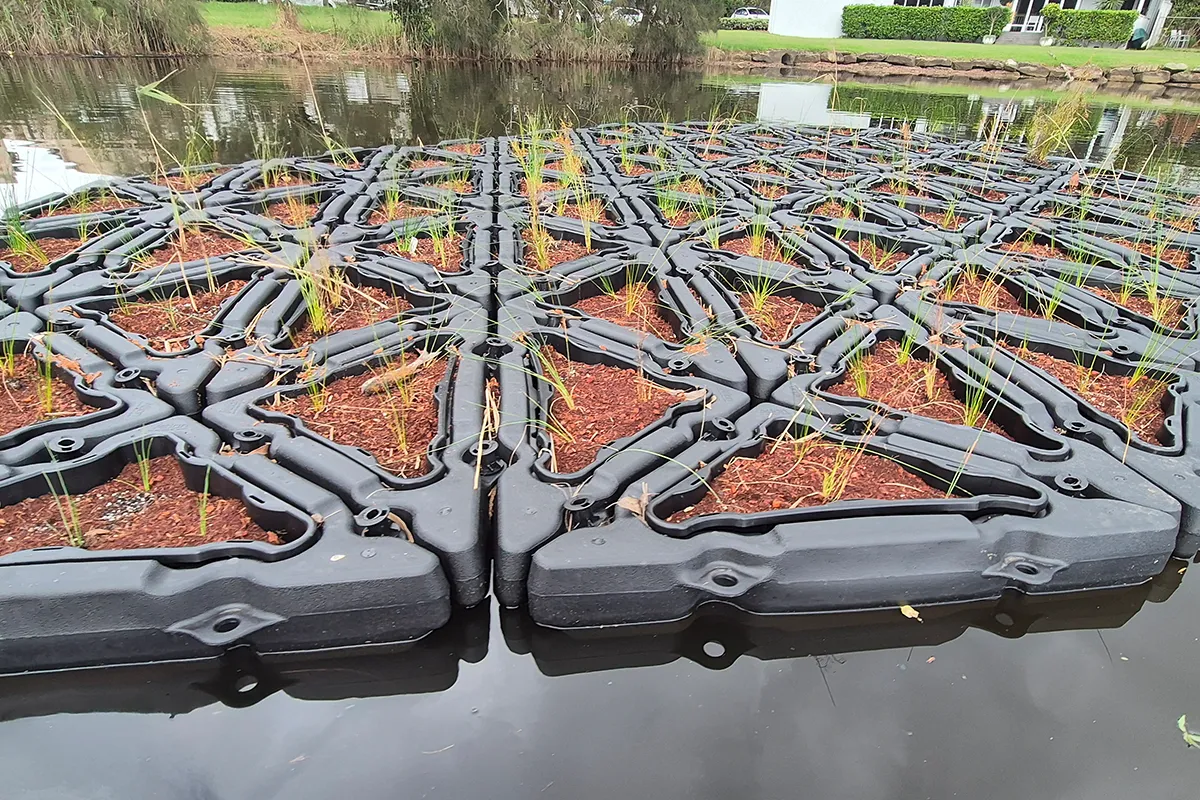
One of the most significant advantages of Floating Treatment Wetlands for municipalities, councils, and local developments, is their retrofit capability. Floating Treatment Wetlands don’t replace stormwater infrastructure – they add additional treatment capability and upgrade it.
Natural wetlands are some of the most effective water filtration systems on the planet. They absorb excess nutrients, trap sediment, filter out pollutants, and support enormous biodiversity. Urbanisation has shrunk the space available for natural wetlands.
FTWs bring these environments back to our urban spaces. By mimicking how natural floating wetland islands function, they restore water treatment, habitat, and ecological balance — and retrofitting these assets means they can be established on existing infrastructure.
Existing stormwater infrastructure such as stormwater ponds and detention basins are traditionally designed for water quantity management rather than water quality. Deploying FTWs on top of these existing assets upgrades their function without the cost, disruption, and land requirements of new construction.
Traditional constructed wetlands rely heavily on land area, retention time, and gravity-driven processes. In contrast, floating wetlands intensify treatment within a smaller footprint – and leverage available space on existing infrastructure.
Reducing Land Take Compared to Traditional Constructed Wetlands
Floating Treatment Wetlands upgrade existing stormwater infrastructure and turn water quantity management assets into active water quality assets, without disturbing existing environments. Key advantages of Floating Treatment Wetlands include:
- Up to 60% reduction in land use compared to conventional wetlands
- Enhanced treatment performance due to increased root surface area
- Improved resilience to fluctuating water levels
- Rapid deployment in existing stormwater infrastructure
This makes them particularly attractive in urban environments where land availability is limited, urban density is increasing, and regulatory pressure on water quality is a priority.
By leveraging natural processes within an engineered framework, Floating Wetlands provide a practical, high-impact solution for improving water quality, restoring ecosystems, and future-proofing infrastructure.
They are often paired with primary treatment technologies such as gross pollutant traps to:
- Capture litter and debris upstream
- Reduce maintenance demands
- Protect plant health and system performance
For projects seeking floating wetlands, artificial wetlands, constructed wetlands or nature-based engineering solutions, Floating Wetlands technology offers a compelling pathway to community beautification, habitat creation, and improved water quality.
FAQ
Why are floating wetlands more space-efficient than traditional constructed wetlands?
Because floating wetlands operate directly on the water surface, they eliminate the need for large land-based construction. Their vertical root systems maximize treatment within the water column, enabling similar or improved performance with significantly less land take which reduces footprint requirements by up to 60%.
Can floating wetlands be retrofitted into existing stormwater infrastructure without major construction?
Yes, floating wetlands are specifically designed for retrofit applications. They can be deployed onto existing ponds, basins, and canals with minimal disruption, transforming underperforming stormwater assets into effective water treatment systems without the need for extensive excavation or redesign.
Why are floating treatment wetlands ideal for retrofitting existing stormwater assets?
Floating treatment wetlands are particularly well-suited to retrofit projects because they can be installed directly onto existing water bodies without altering the underlying infrastructure. This allows municipalities and developers to upgrade legacy stormwater ponds and basins—originally designed for flood control—into effective water quality treatment systems.