
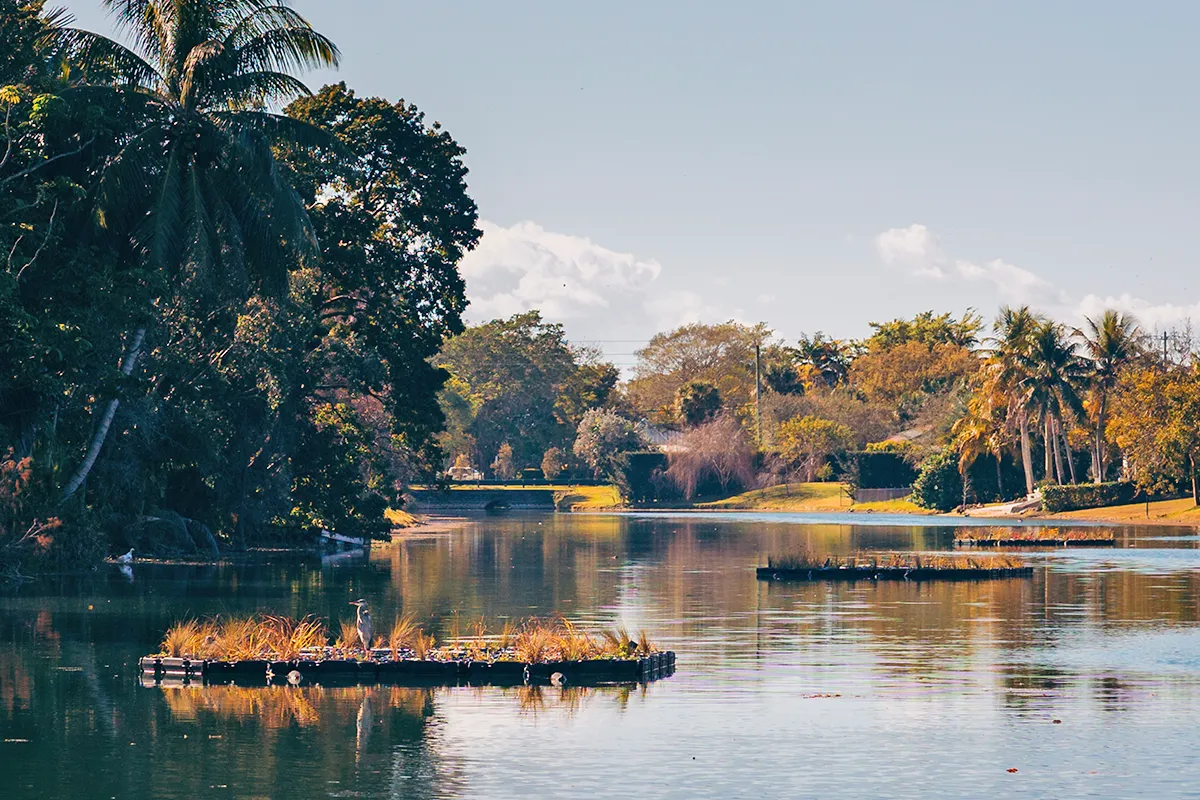
Florida’s canals are one of the state’s defining features — hundreds of miles of urban waterways winding through neighbourhoods, connecting communities, and draining into coastal ecosystems that include Biscayne Bay and the greater Everglades watershed. They’re also one of the state’s most persistent environmental challenges.
Stormwater runoff carries nutrients, sediment, and invasive plant species into these canals, creating conditions that fuel algal blooms, cloud the water, and allow fast-growing weeds to take over. In the Village of Pinecrest, eleven miles south of downtown Miami, Floating Treatment Wetlands are presenting an alternative solution for addressing invasive weed species.
The Pinecrest installation is designed to combine this function with community aesthetics, waterway beautification, and water treatment.
Planted species include native plants with typically selected for their water treatment profiles including Bulrush, Blue Iris, and Golden Rod. On the platform’s inner planting beds, harvestable flowering plants including Celosia, African Marigold, and Lisianthus add color and beauty to the canal environment.
Canal Installation of Three Floating Wetlands Islands
Hydrilla is a fast-growing aquatic invasive plant that’s become one of Florida’s most problematic canal weeds. Growing in dense mats, it crowds out native vegetation, depletes oxygen levels, releases unpleasant odors, and clogs waterways that flow toward Biscayne Bay.
The Pinecrest pilot is exploring whether Floating Treatment Wetlands can offer a more sustainable alternative to herbicide applications, using shade from Floating Wetlands to suppress the growth of Hydrilla while simultaneously improving water quality and providing space for the growth of wetlands plants and flowers.
Atlan Stormwater’s installation in Pinecrest consists of three floating plant islands, each made up of 68 connected modules arranged in a roughly 34-square-meter (110 square foot) footprint.
Two of the islands were funded by the Village of Pinecrest through its Stormwater Fund. All three are being monitored through a partnership with Florida International University with funding supplied by a USDA grant.
Dr. Jazmin Locke Rodriguez leads the research, which is tracking plant growth, nutrient removal, and water quality changes over a two-year period – helping generate field scale data to inform wider adoption of Floating Wetlands in Miami canals.
FAQ
How are floating wetlands being used to manage invasive aquatic species in urban canals?
In Pinecrest’s canal network, floating treatment wetlands are being deployed to suppress invasive species like Hydrilla by increasing surface coverage and shading the water column to compete with these invasive weeds for light and nutrients.
How do floating wetlands support water quality improvements in coastal watershed systems like Biscayne Bay?
Floating wetlands help intercept and treat stormwater pollutants before they reach sensitive receiving waters such as Biscayne Bay. Through nutrient uptake, sediment capture, and microbial processes within the root biofilm, these systems reduce nitrogen, phosphorus, and suspended solids—mitigating eutrophication and protecting downstream aquatic environments.
Why are modular floating wetlands effective for pilot programs and municipal-scale adoption?
Their modular design allows floating wetlands to be easily scaled, reconfigured, or relocated, making them ideal for pilot programs like the Pinecrest installation. This allows performance to be trialled and systems to be expanded as project requirements change.