
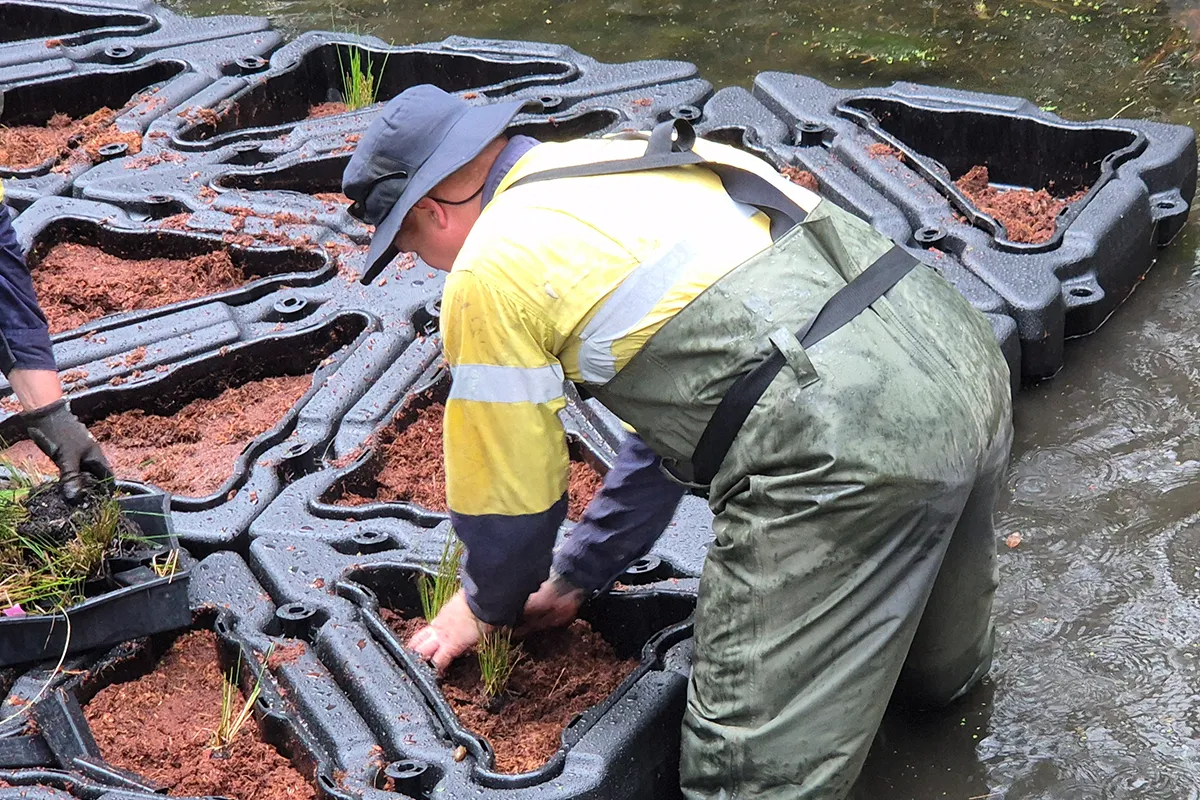
A Floating Treatment Wetland — often called an FTW — is a platform of connected floating modules planted with wetland grasses, rushes, and native plants. These nature-based solutions are floating platforms that allow planted vegetation to grow on the surface of existing ponds, retention basins, canals, estuaries, rivers, streams and lakes.
Atlan Stormwater’s Floating Treatment Wetland are a fully modular configuration of HDPE float and insertable planting basket. As the plants in FTWs grow, their roots extend down into the water column, forming dense networks that filter pollutants, capture sediment, and host the microbial biofilm communities that drive biological water treatment.
The concept behind FTWs is rooted in biomimetics — the practice of applying biological designs to engineering challenges. Natural wetlands are extraordinary water treatment systems. They filter nutrients, bind heavy metals, host biodiversity, and buffer flood events.
Ideal for retrofit applications, FTWs replicate these functions in a compact, deployable format that can be placed directly on existing water bodies. The ability for FTWs to occupy the water surface ensure minimal environmental disruption, minimise land requirements, and conserve nearby foreshore – particularly compared to conventional constructed wetlands.
According to the Ramsar Convention on Wetlands, natural wetlands support around 40% of all plant and animal species on Earth despite covering just 6% of its surface. Urbanization has dramatically reduced wetland coverage in communities across the country. FTWs offer a practical way to reintroduce those ecological functions in places where traditional wetland construction simply isn’t feasible.
Supercharging Pollution Removal Pathways
Wetland plants absorb nutrients like nitrogen and phosphorus directly from the water. These nutrients are then stored in plant biomass, effectively removing them from the aquatic system. Supercharging floating wetland performance is biofilm —a complex community of microorganisms that colonizes the submerged root systems.
Because FTWs float rather than root in shoreline soil, they provide significantly more surface area for biofilm growth than conventional constructed wetlands — which dramatically increases beneficial microbes and stormwater treatment capability. This reduces land take by up to 60% compared to traditional constructed wetland alternatives.
FTWs work through three simultaneous nutrient removal processes:
- Sedimentation — Suspended particles accumulate in the dense root network beneath the platform and settle to the bottom of the water body.
- Plant uptake — Wetland vegetation draws nitrogen, phosphorus, and metals directly from the water column as they grow.
- Microbial biofilm activity — Biofilm communities that develop on the root surfaces drive biochemical processes including nitrification, helping to break down nutrients and micropollutants.
Research published in Environmental Science & Technology found that FTW root systems are effective at trapping microplastics — including tire rubber particles that wash off roads during rain events — in the sediment that builds up beneath the platform. As awareness and regulation around microplastic pollution grows, this is an increasingly important benefit.
From stormwater ponds to lakes, estuaries and fisheries, managing water quality and associated issues such as algal blooms, murky water, or nutrient buildup is crucial. Floating Wetlands are a solution that enhance stormwater treatment outcomes while being delivered at a fraction of the cost of conventional alternatives.
FAQ
How do Floating Wetlands improve stormwater quality in ponds, lakes, and retention basins?
Floating wetlands improve water quality by filtering stormwater through dense submerged root systems that trap sediment, absorb nutrients, and support microbial activity. As water moves through the root zone, pollutants are removed via physical, biological, and chemical processes, resulting in cleaner, healthier waterways.
What pollutants can Floating Treatment Wetlands remove from stormwater systems?
Floating treatment wetlands are effective at removing a range of common stormwater pollutants, including total suspended solids (TSS), nitrogen, phosphorus, heavy metals, and organic matter. They also help reduce nutrient levels that lead to algal blooms and poor water clarity.
How do plant roots and biofilm work together in a Floating Wetland system?
Plant roots provide a large surface area for biofilm—communities of beneficial microorganisms—to grow. These microbes break down nutrients and contaminants through biochemical processes, while the roots physically trap particles and absorb dissolved pollutants, creating a highly efficient treatment system.